

Lithium Battery Laboratory: Essential Equipment, Laboratory Design, and Testing Requirements
A lithium battery laboratory is a specialized facility used to research, develop, characterize, and test lithium-ion batteries and related materials. Depending on its purpose, the laboratory may require equipment for material analysis, electrode preparation, cell assembly, electrochemical testing, environmental evaluation, and battery safety assessment.
Planning a lithium battery laboratory requires more than selecting testing instruments. Equipment configuration must be coordinated with sample workflows, environmental controls, electrical infrastructure, ventilation, fire protection, and the laboratory's intended testing capacity. A well-planned laboratory helps researchers obtain reliable data, improve workflow efficiency, and establish a foundation for future battery technology development.
This guide explains how to plan a lithium battery laboratory, select appropriate equipment, organize functional areas, and evaluate the technical requirements of a battery research or testing facility.
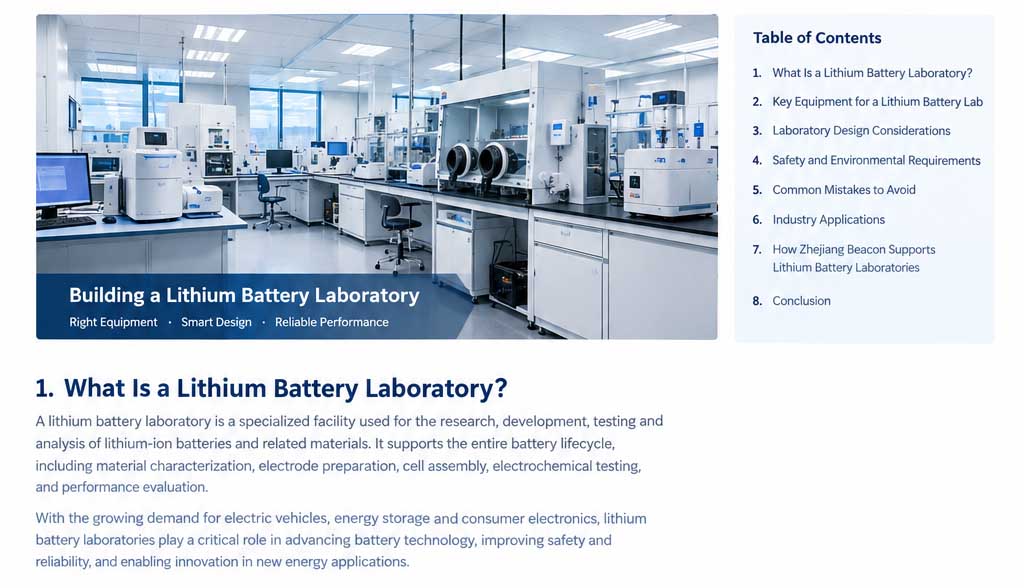
Quick Answer: What Is a Lithium Battery Laboratory?
A lithium battery laboratory is a research or testing facility designed to evaluate battery materials, develop electrodes and cells, measure electrochemical performance, and assess battery reliability and safety. Depending on its scope, it may include material characterization instruments, electrode preparation equipment, controlled-atmosphere workspaces, battery cyclers, environmental chambers, and specialized safety-testing systems. The required configuration depends on the laboratory's research objectives, testing methods, throughput, and safety requirements.
Key Takeaways
-
Define the testing scope first. Material characterization, cell development, performance testing, and safety evaluation require different equipment.
-
Configure equipment around the workflow. Sample preparation, analysis, cell assembly, testing, and data management should be planned as connected processes.
-
Control environmental conditions. Moisture-sensitive materials and processes may require dry rooms, glove boxes, or other controlled environments.
-
Integrate safety into the design. Battery charging, storage, abuse testing, and thermal evaluation require risk-based engineering controls.
-
Coordinate instruments with infrastructure. Electrical capacity, ventilation, utilities, floor loading, and data connections should be checked before procurement.
-
Plan for future development. Modular layouts and appropriate utility capacity can support changes in testing methods and research priorities.
1. What Does a Lithium Battery Laboratory Do?
Lithium battery laboratories support different stages of battery research and development, from analyzing raw materials to evaluating finished cells.
The laboratory's equipment requirements depend on the materials being investigated, the battery chemistry, the cell format, and the testing objectives.
1.1 Battery Material Characterization
Material characterization helps researchers understand the physical, chemical, and structural properties of battery materials.
Typical testing objectives include:
-
Measuring particle size distribution.
-
Evaluating specific surface area and porosity.
-
Analyzing crystal structure and phase composition.
-
Determining elemental composition.
-
Examining particle morphology.
-
Investigating thermal properties and material stability.
These measurements can support the development and evaluation of cathode materials, anode materials, conductive additives, binders, electrolytes, and other battery-related components.
1.2 Electrode Preparation and Development
Electrode development involves preparing material mixtures and converting them into electrodes suitable for cell assembly.
Depending on the research program, equipment may be required for powder weighing, mixing, slurry preparation, coating, drying, calendaring, and electrode cutting.
The configuration should account for material handling, process repeatability, contamination control, and the properties of the electrode formulations being studied.
1.3 Battery Cell Assembly
Battery cell assembly involves preparing and combining electrodes, separators, electrolytes, and other cell components.
Laboratory equipment varies according to the cell format and assembly method. Coin-cell research, pouch-cell development, and cylindrical-cell development may require different tools and workflows.
For moisture-sensitive materials, appropriate environmental controls may be necessary during selected preparation and assembly operations.
1.4 Electrochemical Performance Testing
Electrochemical testing evaluates how a battery behaves under defined operating conditions.
Common objectives include measuring:
-
Charge and discharge capacity.
-
Coulombic efficiency.
-
Cycle life.
-
Rate performance.
-
Voltage profiles.
-
Internal resistance or impedance.
-
Performance under different temperatures or operating conditions.
The selected testing system should support the required current, voltage, channel count, temperature range, and data acquisition needs.
1.5 Battery Safety and Reliability Evaluation
Battery safety testing investigates potential failure mechanisms and evaluates behavior under defined test conditions.
Depending on the laboratory's scope, this may involve temperature exposure, electrical abuse testing, mechanical testing, thermal analysis, or specialized battery safety systems.
Not every research laboratory needs a full abuse-testing facility. Tests involving thermal runaway, short circuits, crushing, penetration, or other hazardous conditions require dedicated risk assessment, suitable containment and protective systems, and qualified procedures.
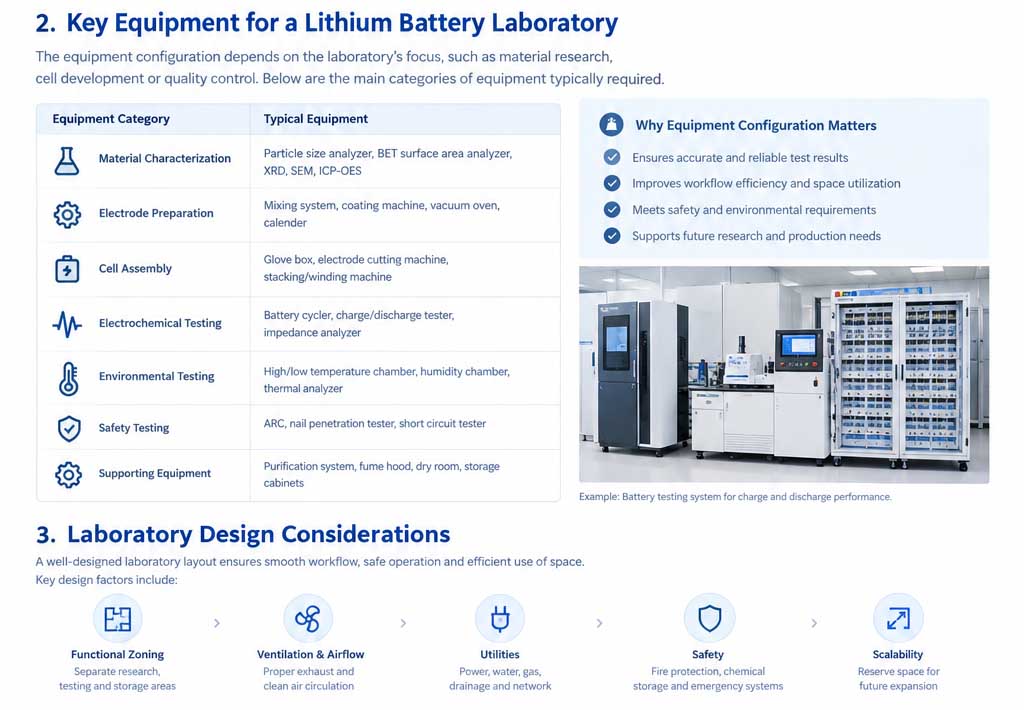
2. What Equipment Is Needed for a Lithium Battery Laboratory?
There is no universal equipment list for every lithium battery laboratory. The appropriate configuration depends on whether the facility focuses on materials research, electrode development, cell assembly, electrochemical testing, quality control, or safety evaluation.
The following table provides a starting point for planning.
| Equipment category | Typical equipment | Main purpose |
|---|---|---|
| Material characterization | Laser particle size analyzer, BET surface area analyzer, XRD, SEM, ICP-OES | Analyze particle properties, surface area, structure, morphology, and composition |
| Sample preparation | Analytical balance, grinder, mixer, drying oven, digestion equipment | Prepare representative samples for testing |
| Electrode preparation | Slurry mixer, coating machine, vacuum oven, calendaring machine, electrode cutter | Prepare and process battery electrodes |
| Controlled-atmosphere processing | Glove box, dry-room systems, moisture monitoring equipment | Support moisture-sensitive handling and assembly |
| Cell assembly | Coin-cell crimper, stacking or winding equipment, filling tools | Assemble battery cells in the required format |
| Electrochemical testing | Battery cycler, charge-discharge tester, potentiostat or galvanostat, impedance analyzer | Measure battery performance and electrochemical behavior |
| Environmental testing | Temperature chamber, humidity chamber where applicable, thermal analysis equipment | Evaluate performance under controlled conditions |
| Safety testing | Specialized battery safety and abuse-testing equipment | Investigate battery behavior under defined hazardous test conditions |
| Supporting infrastructure | Ventilation, electrical distribution, gas systems where required, data systems, storage cabinets | Support safe and reliable laboratory operation |
The table should be treated as a preliminary planning framework. Instrument specifications and the final equipment list must be determined from the actual test methods, sample requirements, applicable standards, and manufacturer documentation.
2.1 Material Characterization Instruments
Material analysis is often a core part of battery research.
Laser particle size analyzer
Measures particle size distribution using a suitable analytical method, commonly laser diffraction. It can help researchers characterize powders used in electrode materials and investigate consistency between material batches.
BET surface area analyzer
Measures specific surface area using gas adsorption methods. Depending on the instrument and analytical method, related systems may also characterize pore properties.
X-ray diffraction (XRD)
Provides information about crystalline phases and structural characteristics. It is useful for studying changes in battery materials during development and testing.
Scanning electron microscope (SEM)
Provides high-resolution images of material morphology and surface features. Additional analytical detectors may enable elemental analysis.
ICP-OES or ICP-MS
Supports elemental analysis where appropriate sample preparation and validated analytical methods are available. The choice depends on required detection limits, elements of interest, sample matrix, and testing objectives.
These instruments are not interchangeable. Selection should be based on the specific property being measured and the level of analytical performance required.
2.2 Electrode Preparation Equipment
An electrode preparation area may include:
-
Precision balances for weighing materials.
-
Mixing systems for preparing electrode slurries.
-
Coating equipment for applying slurry to current collectors.
-
Drying systems for removing solvents under defined conditions.
-
Calendaring equipment for controlling electrode thickness and density.
-
Cutting equipment for preparing electrode dimensions.
The configuration depends on whether the laboratory performs small-scale experimental work, pilot-scale development, or more standardized production-related testing.
Solvent selection and handling, exhaust requirements, material compatibility, and fire protection should be evaluated during the design stage.
2.3 Glove Boxes and Dry-Room Systems
Some lithium battery materials and assembly processes are sensitive to moisture or oxygen.
A glove box can provide a controlled atmosphere for specific operations, while a dry room controls moisture conditions across a larger workspace.
These solutions serve different purposes and should not be selected solely on the basis of nominal humidity specifications.
The design should consider:
-
Required moisture and oxygen levels.
-
Material sensitivity.
-
Frequency of material transfer.
-
Equipment and workstation integration.
-
Monitoring and alarm requirements.
-
Regeneration, maintenance, and operating costs.
-
Safety requirements for the materials and gases involved.
The appropriate solution should be confirmed against the process requirements and the equipment manufacturer's specifications.
2.4 Battery Testing Systems
Battery cyclers and charge-discharge testing systems measure cell performance under programmed electrical conditions.
When selecting a system, review:
-
Voltage and current ranges.
-
Channel count and channel independence.
-
Measurement accuracy and resolution.
-
Programmable test profiles.
-
Temperature-control compatibility.
-
Data export and software functions.
-
Safety interlocks and fault handling.
-
Calibration and service support.
Testing requirements for small research cells may differ significantly from those for large-format cells or battery packs. System capacity should be matched to the actual application rather than selected only for future theoretical demand.
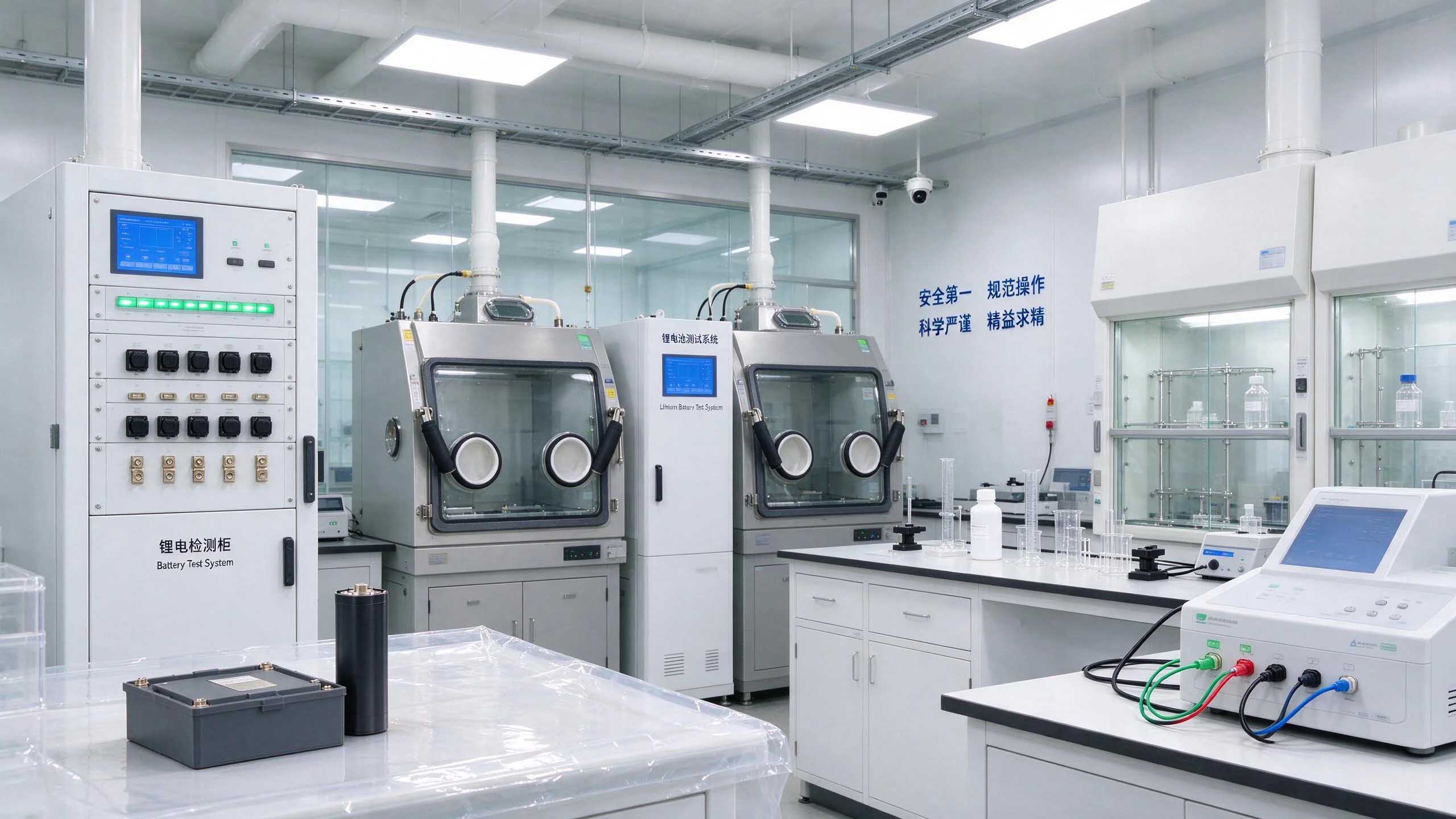
3. How Should a Lithium Battery Laboratory Be Designed?
A good laboratory design aligns the physical environment with the research workflow, equipment requirements, safety assessment, and expected operating capacity.
The final layout should be developed with input from laboratory users, equipment suppliers, facility engineers, and relevant safety professionals.
3.1 Establish Functional Zones
Depending on the laboratory's scope, a lithium battery facility may contain the following functional areas.
| Functional area | Main activities | Planning considerations |
|---|---|---|
| Material storage and receipt | Receive, identify, and store incoming materials | Storage compatibility, labeling, segregation, access |
| Material preparation | Weighing, mixing, grinding, and pretreatment | Dust control, contamination prevention, ventilation |
| Material characterization | Physical and chemical analysis | Instrument stability, utility connections, maintenance access |
| Electrode preparation | Slurry preparation, coating, drying, and cutting | Process sequence, exhaust, solvent handling |
| Controlled-atmosphere area | Moisture-sensitive preparation and assembly | Humidity control, gas systems, monitoring |
| Cell assembly | Prepare and assemble battery cells | Equipment clearances, material flow, process controls |
| Electrochemical testing | Charge-discharge testing and performance evaluation | Electrical capacity, temperature control, monitoring |
| Safety testing | Specialized thermal, mechanical, or electrical tests | Dedicated risk controls and suitable containment |
| Data and support area | Data review, documentation, equipment administration | Network connectivity, access control, record management |
Not every facility requires a separate room for each function. The correct arrangement depends on the risk assessment, equipment footprint, contamination concerns, and applicable requirements.
3.2 Plan Sample and Personnel Flow
A logical workflow reduces unnecessary movement and helps prevent cross-contamination.
A typical research sequence may be:
Material receipt → Sample preparation → Material characterization → Electrode preparation → Cell assembly → Electrochemical testing → Data analysis
Actual workflows may differ. Some analytical tests occur before cell assembly, while post-test material characterization may take place after electrochemical evaluation.
The layout should accommodate these routes without compromising safety, environmental control, or equipment access.
3.3 Confirm Infrastructure Requirements
Before finalizing the layout, identify the infrastructure required by each instrument and process.
Electrical systems
Check power supply, grounding, circuit capacity, equipment start-up loads, and any requirements for dedicated circuits or backup power.
Ventilation and exhaust
Evaluate local exhaust, solvent handling, heat removal, and appropriate discharge arrangements. Exhaust design should reflect the actual materials and processes used.
Environmental control
Determine whether the laboratory needs temperature control, humidity control, a dry room, a glove box, or another specialized environment.
Gas and utility systems
Where required, coordinate gas supply, purity, pressure regulation, monitoring, and safe distribution.
Data infrastructure
Plan network connectivity, instrument software, storage capacity, data backup, access control, and integration with laboratory information systems.
These requirements should be confirmed with equipment manufacturers and qualified engineering professionals before procurement and construction.
3.4 Allow for Installation and Maintenance
Equipment placement must account for more than the instrument's external dimensions.
Consider delivery routes, door openings, lifting requirements, operating clearance, access panels, ventilation connections, and replacement of major components.
For instruments sensitive to vibration, temperature changes, or electromagnetic interference, verify the manufacturer's installation conditions and select suitable locations.
4. Safety Requirements for Lithium Battery Laboratories
Safety should be incorporated into laboratory planning from the beginning. Battery-related hazards depend on the chemistry, cell format, energy content, materials handled, test conditions, and experimental procedures.
A laboratory designed for routine material characterization may not be suitable for high-energy cell testing or destructive abuse tests.
4.1 Chemical and Material Safety
Review the hazards associated with active materials, electrolytes, solvents, gases, and cleaning agents.
The laboratory may require compatible storage, local exhaust, appropriate personal protective equipment, spill-response arrangements, and procedures for handling waste.
Safety measures should be based on chemical hazard information, quantities, and the processes performed.
4.2 Electrical and Charging Safety
Battery testing equipment should be configured according to the cell's electrical specifications and the intended test procedure.
Depending on the application, controls may include overvoltage and overcurrent protection, temperature monitoring, emergency shutdown, suitable wiring, and fault alarms.
Charging and discharging systems should be operated within the limits established for the cells and testing equipment.
4.3 Thermal and Fire Risk Management
Lithium-ion cells can fail under certain electrical, thermal, mechanical, or chemical conditions. Some failures can lead to rapid heat release, fire, or the release of hazardous gases.
A suitable safety strategy may include:
-
A documented battery hazard assessment.
-
Appropriate separation of testing and storage activities.
-
Temperature and fault monitoring.
-
Suitable emergency isolation and shutdown arrangements.
-
Risk-based fire protection and ventilation design.
-
Procedures for abnormal events and damaged cells.
-
Training and emergency-response planning.
High-risk testing may require a dedicated test enclosure or room with engineered protection. The exact design should be determined by qualified specialists using the specific test conditions, applicable codes, and the facility's risk assessment.
4.4 Safety Testing Requires Specialized Planning
Tests involving crushing, penetration, external short circuits, overcharging, or thermal abuse should not be treated as routine bench experiments.
Before introducing these tests, confirm the test method, energy levels, equipment limits, containment provisions, monitoring systems, emergency procedures, and personnel qualifications.
Where relevant, review the applicable battery testing standards and regulatory requirements for the intended market and product category.
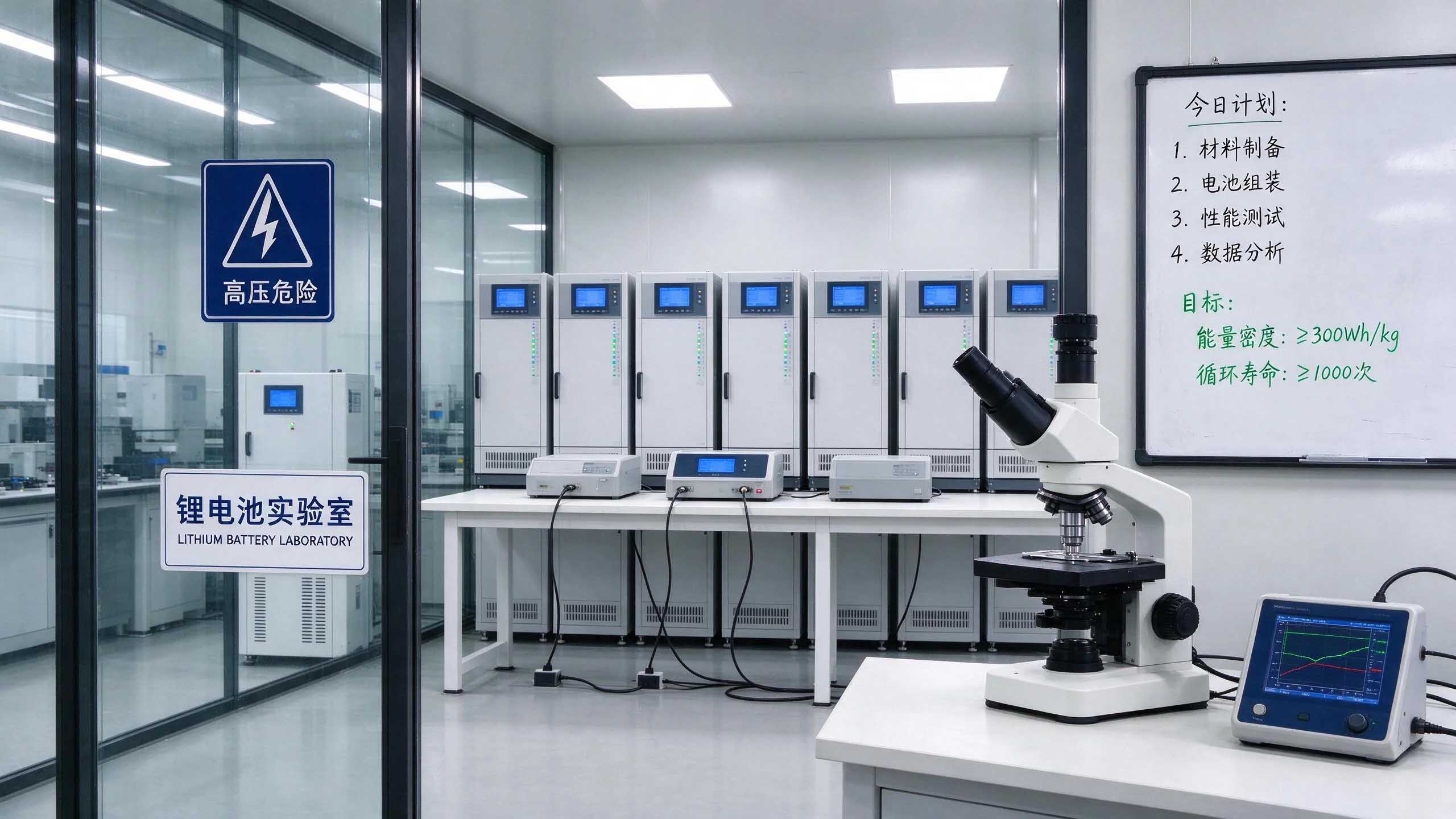
5. How to Select Equipment for a Lithium Battery Laboratory
Equipment selection should begin with the required measurement or process outcome and then move to instrument specifications.
5.1 Define the Application
Identify the materials, cell formats, testing methods, and research objectives.
For example, a laboratory focused on cathode powder characterization may prioritize particle size analysis, surface area measurement, XRD, and elemental analysis. A cell development laboratory may need electrode preparation, controlled-atmosphere assembly, and electrochemical testing systems.
5.2 Compare Technical Specifications
Prepare a comparison matrix for shortlisted instruments.
| Selection factor | Questions to ask |
|---|---|
| Measurement capability | Does the instrument support the required method and measurement range? |
| Sample compatibility | Can it handle the actual sample type and preparation procedure? |
| Throughput | Can it support the expected number of tests? |
| Repeatability | Is the performance appropriate for the intended use? |
| Environmental requirements | Does it require controlled temperature, humidity, or vibration? |
| Integration | Can it exchange data with the required software or systems? |
| Installation | Are the utilities, space, and site conditions available? |
| Maintenance | Are calibration, consumables, spare parts, and service support available? |
| Safety | Are necessary interlocks, monitoring, and protective features provided? |
| Expansion | Can capacity or functionality be extended if requirements change? |
5.3 Evaluate Total Ownership Cost
The acquisition price is only one component of the overall laboratory investment.
Consider installation, supporting infrastructure, consumables, calibration, maintenance, software, operator training, and the expected operating life.
A lower-cost instrument may be suitable for one application but inadequate for another. Compare options against documented requirements and the actual workload.
5.4 Review Supplier Documentation
Before placing an order, request relevant technical specifications, installation requirements, operating manuals, service information, and acceptance criteria.
For critical instruments, clarify responsibilities for delivery, installation, commissioning, training, and performance verification.
This reduces uncertainty during project implementation.
6. Common Mistakes in Lithium Battery Laboratory Planning
Choosing Equipment Before Defining the Research Scope
A generic equipment list can result in unnecessary purchases or gaps in analytical capability. Start with the intended testing methods and sample workflows.
Underestimating Environmental Control
Some materials and assembly procedures require tightly controlled moisture or oxygen levels. These requirements can influence room design, utility planning, and operating costs.
Treating All Battery Testing as the Same
Material characterization, cell performance evaluation, pack testing, and destructive safety testing involve different equipment and risk profiles. They should be planned as distinct activities where appropriate.
Ignoring Equipment Interfaces
A laboratory may contain suitable individual instruments but still experience workflow problems if sample handling, utilities, software, or installation responsibilities are not coordinated.
Leaving Safety Until the End
Retrofitting ventilation, containment, monitoring, or emergency provisions can be difficult after the layout and equipment locations have been finalized. Safety requirements should be established during early planning.
Failing to Plan for Data Management
Battery research often generates large volumes of test data across multiple instruments and test channels. Define file formats, metadata, naming conventions, access permissions, backup procedures, and data review responsibilities early.
7. What Is the Process for Building a Lithium Battery Laboratory?
A structured implementation process helps align research needs with facility design, procurement, installation, and operational readiness.
Stage 1: Requirements assessment
Define the laboratory's applications, testing methods, sample throughput, equipment needs, and applicable safety requirements.
Stage 2: Concept planning
Develop preliminary functional zones, workflow diagrams, an initial equipment list, and a space plan.
Stage 3: Technical design
Confirm instrument specifications, utility requirements, ventilation, environmental controls, electrical capacity, and safety provisions.
Stage 4: Procurement and coordination
Compare suitable instruments, confirm delivery schedules, and coordinate equipment interfaces with the construction and engineering teams.
Stage 5: Installation and commissioning
Prepare the site, install the equipment, complete appropriate checks, and resolve installation issues.
Stage 6: Verification and training
Confirm that equipment meets defined acceptance criteria, provide operator training, and establish operating and maintenance procedures.
Stage 7: Routine operation and improvement
Monitor equipment performance, maintenance needs, workflow efficiency, and changes in research requirements.
The time and complexity of each stage depend on project scope, equipment lead times, building conditions, and the degree of specialization required.
8. How Zhejiang Beacon Supports Lithium Battery Laboratory Projects
Zhejiang Beacon Instrument Co., Ltd. provides laboratory-related services covering planning and design, engineering construction, customized laboratory furniture, instrument and equipment configuration, automation systems, and technical support.
For a lithium battery laboratory project, equipment selection should be coordinated with the intended research activities, material handling requirements, space allocation, utilities, and safety planning.
A structured planning process can help project teams identify equipment requirements early, coordinate installation conditions, and clarify the interfaces between instruments and supporting systems.
To prepare a project-specific configuration, the following information is useful:
-
The laboratory's primary research or testing objectives.
-
Battery chemistry and material types.
-
Planned cell formats and testing methods.
-
Required analytical instruments and performance ranges.
-
Expected sample volume and testing throughput.
-
Available floor area and existing infrastructure.
-
Environmental control and safety requirements.
-
Plans for future expansion or automation.
The final equipment schedule should be developed from these requirements rather than applying the same configuration to every battery laboratory.
Learn more about Zhejiang Beacon's laboratory services on the official website.
9. Frequently Asked Questions About Lithium Battery Laboratories
What equipment is required for a lithium battery laboratory?
The equipment depends on the laboratory's scope. A materials laboratory may need particle size analyzers, BET analyzers, XRD, and elemental analysis systems. A cell development laboratory may also require electrode preparation tools, glove boxes, cell assembly equipment, and battery cyclers.
What is the difference between a battery research laboratory and a battery testing laboratory?
A battery research laboratory generally focuses on developing materials, electrodes, cells, or new testing methods. A battery testing laboratory may focus on standardized performance measurements, quality control, reliability assessment, or safety testing. Their equipment requirements can overlap, but their workflows and qualification needs may differ.
Does every lithium battery laboratory need a dry room?
No. A dry room is required only when the processes and materials justify that level of environmental control. Some operations may be performed using a glove box or other controlled-atmosphere equipment. The appropriate solution depends on moisture sensitivity, process scale, workflow, and technical requirements.
Which instruments are useful for battery material characterization?
Common instruments include laser particle size analyzers, BET surface area analyzers, XRD, SEM, and ICP-OES or ICP-MS systems. Each serves a different analytical purpose, so the selection should be based on the material properties that need to be measured.
What should be considered when designing a lithium battery laboratory?
Key considerations include functional zoning, sample flow, equipment footprint, utilities, moisture control, ventilation, electrical capacity, chemical storage, fire protection, emergency procedures, and future expansion.
How can a lithium battery laboratory improve testing efficiency?
Efficiency can be improved through a logical sample workflow, suitable equipment capacity, standardized procedures, effective scheduling, appropriate automation, and consistent data management. Equipment selection should address the actual bottlenecks rather than simply increasing instrument count.
What safety measures are important in battery testing?
Important measures include hazard assessment, appropriate electrical protection, temperature monitoring, suitable ventilation, controlled storage, emergency shutdown arrangements, and risk-based fire protection. Specialized abuse testing requires additional engineering controls appropriate to the specific test conditions.
How should battery testing equipment be selected?
Compare instruments based on the required voltage and current ranges, channel count, accuracy, test profiles, temperature compatibility, data functions, safety features, calibration, and service support. Confirm that the selected system is suitable for the intended cell format and test method.
Can one laboratory support both battery materials research and cell testing?
Yes, if the facility is designed around the required workflows and safety conditions. Separate functional zones or controlled environments may be needed for certain activities, and the configuration should account for material transfer, contamination control, and the different infrastructure needs of each process.
Conclusion
A lithium battery laboratory requires a coordinated combination of analytical instruments, sample preparation systems, cell assembly equipment, electrochemical testing systems, environmental controls, and safety provisions appropriate to its intended applications.
The most effective configuration begins with a clear definition of the laboratory's testing objectives. From there, equipment specifications, functional zoning, utilities, supplier responsibilities, installation, and verification can be planned as connected parts of the same project.
For laboratories involved in battery materials research, cell development, or performance evaluation, integrating equipment configuration with laboratory design and engineering planning provides a practical foundation for reliable testing and future development.
About Zhejiang Beacon Instrument
Zhejiang Beacon Instrument Co., Ltd., established in 2013 and headquartered in Ningbo, Zhejiang, China, provides integrated laboratory solutions for industrial, research, and testing applications. Its services cover laboratory planning and design, engineering and construction, customized laboratory furniture, analytical instrument configuration, laboratory automation, and supporting systems.
Beacon's EPC-oriented approach brings together laboratory infrastructure, equipment selection, and workflow requirements within a coordinated project framework. Its published project portfolio includes laboratory development and equipment integration for new-energy batteries, advanced materials, and industrial testing applications. Depending on project requirements, laboratory planning may address instrument placement, utilities, ventilation, sample workflows, and future expansion.
By coordinating design, engineering, equipment configuration, and implementation, Beacon helps customers develop laboratory environments suited to their technical objectives and operational requirements. Specific equipment configurations and engineering specifications should be determined according to the intended application, site conditions, safety requirements, and applicable standards.


